
🥩 The New Dietary Guidelines
Our mission is to promote the benefits of animal-based eating and fight back against anti-meat rhetoric. Consider subscribing to support our mission!
🥩 Hello Meatlings,
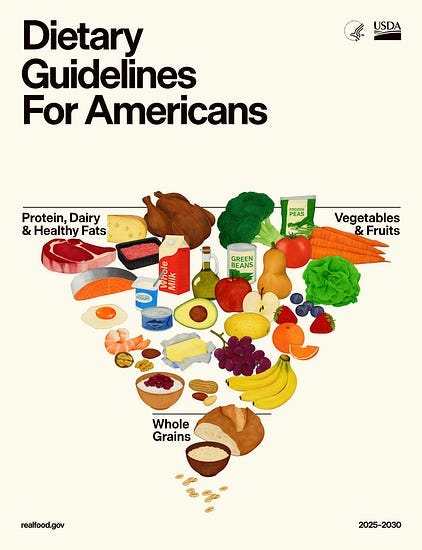
In terms of plant-based diet propaganda, we’ve finally made it out of the woods! Whew - that was a rough few years. The new version of the upside-down food pyramid moves much closer to what I think of as a healthy diet than previous versions and is very much in alignment with what I recommend my clients eat. Animal products at the top. Refined grains are at the bottom, in very minimal quantities, and sugar is absent entirely.
The focus on plant-based eating was a food cult stemming from observational epidemiology (poor science to use for clinical outcomes) and the direct cause of the cholesterol dogma we’ve had the last 50 years i.e., animal products are major sources of saturated fats that increase your cholesterol and increase your risk of heart disease (not actually true).
In previous versions of the dietary guidelines, ALL guidance had to be reconciled with a fundamental goal of keeping LDL cholesterol low. I.e., a healthy diet HAD to be an LDL-lowering diet. That meant minimal meat and dairy products, both significant sources of saturated fat, and eating ultra-processed food was an acceptable evil as long as it was carbohydrates and plant-based foods.
The new guidelines represent a shift in nutritional paradigms: serum cholesterol is no longer the center of the health universe in this paradigm; blood sugar is, and so the insulin response to the foods we eat - Yay! The new message is to consume unprocessed whole foods, animal or not. These are the foods that require minimal insulin to control blood sugar.
The acknowledgement toward the end of the 10-page document that “individuals with certain chronic diseases may experience improved health outcomes when following a lower carbohydrate diet,“ is itself an acknowledgement that for many of us, the fewer the carbohydrates we consume, the healthier we will be.
✌🏻and ribeyes,
-Miranda Ebner, Licensed Nutritionist (get telehealth nutrition support!) and The #Yes2Meat Team
PS: Do you have content ideas? What do you want to learn more about? I’d love to hear your comments for future posts!
📰 News & 🔬 Research
🤰This research on ultra-processed foods in pregnancy is mind-blowing.
For the Moms:
A comprehensive analysis of 22 studies (2019–2024) looked at how ultra-processed food (UPF) intake during pregnancy affects outcomes for both mom and baby. PMID: 39662587.
UPFs were linked to a 48% greater risk of gestational diabetes, and those who developed GD had poorer blood sugar control if they ate a lot of UPFs.
Higher UPF intake was tied to a 28% higher risk of preeclampsia (often described by the medical community has having an unknown cause).
Biomarker data showed lower levels of key nutrients (carotenoids, vitamin A, selenium, and folate) and higher levels of inflammation and oxidative stress in those who ate more UPFs.
For the Baby:
Higher maternal UPF intake was associated with slower fetal growth, including smaller head circumference and femur length.
At ages 4–5, kids whose moms had higher UPF intake scored lower on verbal tests and showed more ADHD-related symptoms.
Maternal UPF intake was also linked to greater adiposity and metabolic disturbances in children.
One big factor: UPFs displace nutrient‑dense whole foods. In all 9 studies that examined overall diet quality, women with the highest UPF intake consumed far less protein, fiber, zinc, magnesium, potassium, and vitamins A, C, D, B12, and folate, indicating lower overall diet quality. These “empty calories” mean less real food and therefore less of the building blocks that babies need for optimal development.
This review reinforces something you’ve heard from me before: diet quality matters.
One of my primary suggestions is when you are family planning, both partners need to optimize their nutrition as much as possible beyond taking a prenatal. Healthy parents equal healthier babies. This also help to blunt the impact of any less healthy dietary changes that are common in the first trimester.
📰 News
🫀The highly anticipated new U.S. Dietary Guidelines for Americans will be released to the public on 1/7/26: Nina Teicholz reports the new guidelines are expected to be only about eight pages, far shorter than the 100+ tomes of previous administrations. The one widely touted reform was an “end to the war on saturated fat,” as both HHS Secretary Robert F. Kennedy, Jr., and FDA Commissioner Marty Makary have repeatedly pledged since taking office—including as recently as Nov 27th. This was a revolutionary proposal. The cap on saturated fats has been a bedrock piece of advice since the launch of this policy in 1980, and it is why so many Americans avoid red meat, drink skim milk, and opt to cook with seed oils over butter.
Yet she learned from two administration officials that saturated fats will not be liberated after all. The longstanding 10% of calories cap on these fats will remain.
At the same time, the guidelines’ language will encourage cooking with “butter” and “tallow,” both of which are high in saturated fat. It will also introduce a colorful new food pyramid with proteins—including red meat—occupying the largest portion. These are powerful messages, never before conveyed by our national food policy, and are likely to influence consumer behavior.
Other revamped guidelines she’s learned:
• The limit on sugar will be dramatically lowered, from the current limit of 10% of calories to possibly 2% of calories, although that target may be for children only.
• A low-carbohydrate diet will be included as a possible option for people with obesity, diabetes, and perhaps other metabolic diseases. This is a huge win and one for which the Nutrition Coalition, the non-profit group Nina founded, has been advocating since 2020.
This new low-carb option will be included in a section entitled “special considerations,” even though 93% of American adults are metabolically unhealthy, according to a 2022 paper based on government data, making low-carb seem logical as a more mainstream approach. An important caveat here is that achieving a low-carbohydrate diet, which is almost always higher in fish, meat, dairy, butter, and fat generally, will be impossible with the continued 10% cap on saturated fats.
• A new food pyramid will be introduced. The original pyramid from 1992 (retired in 2005) had breads, cereals, and crackers at the base—altogether 7-11 servings of grains per day. This hefty load of grains has been widely criticized, especially since the current guidelines still require that half of those servings be refined grains. The new pyramid will replace that bottom slab of grains with proteins: meat, dairy, peas, legumes, and beans. Grains will be reduced to a smaller slab. She’s hearing only 2-4 servings per day, which would be a dramatic improvement.
• This new food pyramid will be upside down, in dramatic fashion, to show that this administration is ‘flipping the pyramid.’
Contradictory Policy Problem
But there’s another audience: the roughly 30 million children eating school lunches daily, plus military personnel, and the vulnerable populations—elderly and poor Americans—who receive food through federal programs, roughly 1 in 4 Americans each week. These programs are required by law to follow the Dietary Guidelines. For them, the numerical cap will trump any contrary language about butter and tallow. Cafeteria managers and program administrators will continue to adhere to the 10% limit, because that’s what the law requires.
How can anyone eat butter, tallow, and red meat while adhering to the 10% cap? They can’t. The messages are impossible to reconcile. The 10% cap means approximately 20-22 grams of saturated fat daily for the average 2,000-calorie diet. Here’s what that looks like in practice:
1 cup whole-fat yogurt for breakfast: ~5 grams
1 chicken thigh with skin, cooked in 1 tablespoon butter for dinner: ~12 grams
Total: ~17 grams of saturated fat
That’s nearly your entire day’s allowance in just two modest meals—no cheese, no butter on your vegetables. Add a splash of cream to your coffee, and you’re over the limit. For these captive populations, seed oils will remain the mandated cooking fat. The encouraging words about butter and tallow will essentially be meaningless.
The Protein Paradox
She’s also learned that the new guidelines will increase the recommended amount of protein from the current RDA minimum of about 0.8 grams per kilogram of body weight to 1.2-1.5 grams. This is genuinely good news. Studies show this higher range is far better for weight loss, muscle maintenance, recovery from serious illness, and overall well-being—especially for school-aged children and older adults, two populations whose protein needs have been chronically underserved by current recommendations.
But here’s the paradox: with the cap on saturated fats still in place, this increased protein cannot realistically come from animal sources. A 4-ounce serving of lean beef provides 24 grams of protein but also delivers about 6 grams of saturated fat. Meeting the higher protein targets through beef, pork, or chicken thighs with skin would blow through the saturated fat limit by lunchtime.
So where will this protein come from? The only options that fit within the 10% saturated fat cap are peas, beans, and lentils—plant proteins that are mostly incomplete (lacking at least one of the nine essential amino acids), harder for the body to absorb, and packed with starch. To match the protein in 4 ounces of beef, you’d need over six tablespoons of peanut butter—between 500 and 600 calories, compared to 155 for the beef.
Paradoxically, this is exactly what the Biden administration’s expert committee wanted: more peas, beans, and lentils replacing animal proteins. More plant-based foods have been a progressive agenda item for years. Kennedy, who has publicly described his own diet as “mostly carnivore,” is thus fulfilling the exact report he pledged to reject.
This creates yet another contradiction. The new food pyramid will feature animal proteins—visually suggesting Americans should eat more meat and dairy. But given the saturated fat cap, that slab should really be filled with peas, beans, and lentils. The image will say one thing; the math will require another.
Read more about her thoughts here.
🙋♀️ Support Your Animal-Based Lifestyle Virtually with Miranda @ Thrive Nutrition
Get help from Miranda, a licensed nutritionist who helps clients reach their weight goals, fix their gut, reverse their diabetes, and heal emotional eating while eating delicious and nourishing foods. Get collaborative support and enjoy lasting results. Use insurance for FREE sessions! Insurance accepted: Aetna, United Healthcare, BCBS (PPO plans), and Medicare. Start with a free 30-minute phone consultation. Subscribers get 10% off with code Yes2Meat
🥩 Support The Yes2Meat Newsletter
The Yes2Meat community is a hub to unite like-minded people to share, collaborate, commerce, and help grow the world’s most important movement for change. If you want to support us, you can become a subscriber below. 👇🏻
🙏🏻 Our Supporters
Using our affiliate links supports the project and helps us reach more people
Carnivore Bar → A hand-made beef tallow bar with a 25-year shelf life. It is the most delicious and nutritious on-the-go bar in existence. Grab a box today! Use code Yes2Meat at checkout for 10% off.
Thrive Nutrition → Personalized nutrition counseling using real food to reverse disease or augment good health. Burn fat, fix your gut, heal emotional eating, and more.
The Better Human Newsletter by Colin Stuckert, health founder and long-time animal-based eater, is free, weekly, and full of valuable ways to be a better human.
Wild Foods → Sourcing the highest-quality foods and supplements from around the world. 🥩 Animal-Based Stack from Wild Foods: Readers get 10% off with code: Yes2Meat
👋 The Yes2Meat Team
Miranda MS, LN, Chief Nutritionist and Editor
Thank you for reading Yes2Meat. This post is public, so feel free to share it.